Patch Test for Allergy

What is a Patch Test?

A patch test is a test performed on a patient and currently represents the standard method for diagnosing a contact allergy to the skin or near-skin mucous membranes (e.g., allergic contact dermatitis). The patch test was introduced to medicine as early as 1895 and has been continuously improved since then.

Why does the doctor use the epicutaneous test?

If the appearance or history of a skin disease indicates that this disease – usually eczema – is caused by skin contact with substances that can cause hypersensitivity (allergies), this test is used. It therefore indicates whether a patient is sensitized to one or more substances. It does not matter if the suspected substances come from the patient’s private environment (such as cosmetics) or occur in the workplace.

How is the test performed?

The substances to be tested can be obtained from a pharmaceutical company as so-called diagnostics, but one could also use cosmetics used presently by the patient for a patch test when it is suspected some of them may no longer be tolerated.

The test substances are applied to a specially prepared test patch, which is usually fixed in the area of the upper back on the skin of the patient. The area where these patches will be applied needs to be marked with a skin marking pen before this will be done. The plaster is then left in this position for 48 hours, after which it is removed, and 20-30 minutes later, the first “reading” can be made. Another so-called final reading is usually carried out after 72 hours, sometimes even 96 hours.

Example: on a Monday, the patches will be put onto the patient’s back, the following Wednesday, the first reading takes place after the patches have been removed, on Thursday or Friday the final reading and discussion of the result takes place.

Depending on the skin reaction in the places where the test material was attached, you can see whether or not the person is allergic to contact with certain substances.

The following results may occur:

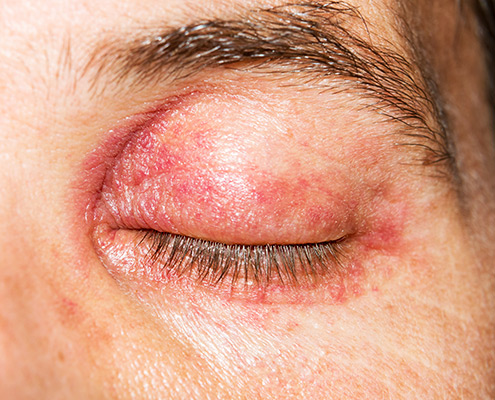
If the skin remains normal, there is probably no allergy to the tested substances. If the skin is changed (reddened, dotted, small blisters), there is a contact allergy – depending on the strength of the reaction – to a pronounced contact allergy.

In the case of a blistering or a weeping inflammation of the skin, one has also to consider the possibility of a toxic contact reaction (not allergic, but directly caused by the chemical effect of the substance); therefore, caution should be exercised when testing undefined (and undiluted) occupational substances (such as drilling and cutting oils).

Through patch testing our Dermatologists can test a relatively large number of potential allergens at the same time. The most common contact allergens are contained in the so-called standard series. In addition to that, there are specially tailored test series for special, job-specific questions (for example for hairdressers, metalworkers, etc.).

If the results are available, the physician discusses the relevance with the patient. The findings may also explain the symptoms and why your Dermatologist initially suggested to test. Furthermore, the importance of perhaps coincidentally detected sensitisations is discussed with the patient and you receive a corresponding allergy pass.

In which situations is the test not performed?

The test should then not be performed if the underlying disease is still “active”, that means it has not completely healed yet – otherwise the patient could flare up. In addition, the back of the patient should not have been exposed to intense sunlight (including a visit to a sunbed!) previous to the test. A pre-treatment of the skin with strong steroid creams or ointments should also have been stopped at least ten days before the patch test.

Furthermore, the test should not be carried out if there is not a good reason for doing so. This means, for example, that the test can not be used to “predict” any future allergy developments. It can also not help to explain symptoms that do not fit the common signs of a contact allergy.

Which risks are associated with a test?

Basically it is – due to decades of experience – a very safe test procedure. However, the following, albeit very rare, risks and undesirable effects should be mentioned.

Sensitisation may occur through the test, that means the patient is allergic to something he was previously not allergic to after the test (this is known, for example, in the testing of so-called para-group substances, e.g., para-phenylenediamine).

In the case of very strong test reactions, small scars, but also hypertrophic scars or even keloids, can occur at these test sites. In addition to that, a change of pigmentation at the test sites is possible.

However, these risks are extremely low and depend on proper testing and experience.